Vol. 11, No. 1 (jul. 2026), eblg003
Updated: Jul 13
GREEN CORROSION INHIBITORS FOR CARBON STEEL PROTECTION IN ACIDIC MEDIA: A SUSTAINABLE APPROACH
Blog Prof. Ricardo Luiz Perez Teixeira, Itabira, Version 01, v. 11, n. 1, eblg003, 2026.
ISSN: 3086-5557
06/07/2026
Daniele Cristina Coelho¹, Ricardo Luiz Perez Teixeira²
¹Materials Engineering Undergraduate Student
Federal University of Itajubá (UNIFEI), Itabira Campus
Rua Irmã Ivone Drumond, 200, Distrito Industrial II
Itabira, Minas Gerais, 35903-087, Brazil
E-mail: daniiele133@gmail.com
²Professor, Institute of Integrated Engineering (IEI)
Federal University of Itajubá (UNIFEI), Itabira Campus
Rua Irmã Ivone Drumond, 200, Distrito Industrial II
Itabira, Minas Gerais, 35903-087, Brazil
E-mail: ricardo.luiz@unifei.edu.br
Abstract
Carbon steel is widely used in sectors such as construction, mining, transportation, and oil and gas production due to its favorable mechanical properties, availability, and cost-effectiveness. Despite these advantages, its susceptibility to electrochemical degradation in acidic environments remains a major challenge for materials and metallurgical engineering. Acidic solutions used in industrial processes such as pickling, descaling, boiler cleaning, and oil-well acidification accelerate anodic iron dissolution and cathodic hydrogen evolution reactions, resulting in significant economic losses and reduced service life of metallic components (Gentil, 2011; Jones, 1996).
This study presents an extended review of environmentally friendly corrosion inhibitors derived from plant extracts and agro-industrial residues for the protection of carbon steel in acidic media. The work was developed through a qualitative, descriptive literature review of books, scientific articles, technical reports, and educational materials on corrosion science, sustainability, and surface engineering. Educational initiatives emphasizing corrosion science and metallurgical processing have also demonstrated the importance of integrating engineering education, scientific dissemination, and practical learning activities in undergraduate programs (Teixeira, 2016, 2019a, 2019b).
The corrosion process in acidic media is governed by coupled electrochemical reactions occurring at the metal–electrolyte interface. Green inhibitors act predominantly through adsorption mechanisms that promote the formation of a protective molecular film on the metallic surface. Such compounds commonly contain heteroatoms, including oxygen, nitrogen, and sulfur, as well as aromatic π-electron systems that can interact with active adsorption sites. As illustrated in Figure 1, the adsorption of organic molecules blocks anodic and cathodic reaction sites, thereby reducing charge transfer and the corrosion rate. These mechanisms have been consistently reported for natural extracts rich in flavonoids, tannins, alkaloids, phenolic compounds, and organic acids (Rocha et al., 2014; Verma et al., 2018).
The literature demonstrates that inhibition efficiency depends on molecular structure, adsorption affinity, concentration, and environmental conditions. Extracts obtained from Citrus sinensis peels have achieved inhibition efficiencies exceeding 90% in hydrochloric acid solutions, owing to the presence of limonene and flavonoids. Similarly, spent coffee grounds (Coffea arabica) have demonstrated inhibition efficiencies ranging from approximately 88% to 94%, owing to their content of chlorogenic acid, caffeine, and phenolic compounds that form compact protective layers on steel surfaces (Santos et al., 2017). Recent reviews have emphasized that plant-derived extracts and agricultural residues are among the most promising environmentally sustainable alternatives for corrosion mitigation in ferrous alloys exposed to aggressive acidic environments (Salleh et al., 2021; Verma et al., 2021).
As summarized in Table 1 and conceptually illustrated in Figure 2, adsorbed inhibitor films form an effective barrier between the electrolyte and the metallic substrate, reducing localized attack and enhancing surface integrity. In addition to corrosion protection, these materials contribute to waste valorization, circular-economy strategies, and green chemistry principles. Consequently, green inhibitors constitute a technically feasible and environmentally responsible approach for extending the service life of metallic structures while reducing the environmental impact associated with conventional corrosion-control technologies (Verma et al., 2018; Verma et al., 2021).
Keywords: green corrosion inhibitors; carbon steel; acidic media; adsorption; electrochemical corrosion; sustainability; materials engineering.
Introduction
Corrosion remains one of the most significant degradation phenomena affecting metallic materials and industrial infrastructure. Carbon steel, despite its widespread use, exhibits limited resistance in acidic environments, necessitating protective strategies to mitigate material loss and economic damage. Traditionally, corrosion protection has relied on synthetic organic inhibitors; however, environmental concerns associated with toxicity and waste generation have increased interest in sustainable alternatives derived from renewable resources (Gentil, 2011; Jones, 1996).
Among these alternatives, plant extracts and agro-industrial residues have emerged as viable sources of green inhibitors because they contain bioactive molecules that adsorb onto metallic surfaces and reduce electrochemical activity. Recent studies have demonstrated that these materials can achieve inhibition efficiencies comparable to those of commercial inhibitors while offering environmental and economic advantages (Rocha et al., 2014; Verma et al., 2018).
This study was conducted within the framework of the UNIFEI extension project**"Seminar on Corrosion and Materials Degradation – EMTi21" (PJ167-2026)**, which promotes the integration of teaching, research, and extension activities through scientific communication, engineering education, and technological dissemination in Materials Engineering.
Methodology
A qualitative, exploratory, and descriptive literature review was conducted. Scientific publications indexed in academic databases, as well as specialized references on corrosion and materials engineering, were analyzed. Priority was given to studies reporting gravimetric analyses, electrochemical impedance spectroscopy (EIS), potentiodynamic polarization techniques, adsorption behavior, and inhibition efficiency data for carbon steel exposed to hydrochloric and sulfuric acid solutions.
The review also incorporated educational and extension-oriented references that support the dissemination of corrosion science knowledge and engineering training activities (Teixeira, 2016, 2019a, 2019b).
Results and Discussion
The reviewed studies indicate that adsorption is the primary mechanism underlying corrosion inhibition by natural extracts. Adsorption may occur via physisorption, chemisorption, or a combination of both, producing a protective layer that reduces electron transfer and limits the access of aggressive ionic species to the metallic substrate.
As shown in Figure 1, inhibitor molecules adsorb onto the steel surface, reducing the availability of active sites for anodic iron dissolution and cathodic hydrogen evolution. This phenomenon directly contributes to reduced corrosion rate and enhanced surface stability.
The inhibition performance reported in the literature shows a strong dependence on the extract's chemical composition. Citrus-derived residues have shown excellent protective behavior because of their limonene and flavonoid content, while coffee-derived residues benefit from caffeine and chlorogenic acid adsorption. The comparative efficiencies summarized in Table 1 demonstrate that agro-industrial by-products can be transformed into value-added corrosion-control materials.
Most green inhibitors exhibit mixed-type behavior, meaning that they simultaneously affect anodic and cathodic electrochemical reactions. Consequently, reductions in corrosion current density are often observed without substantial shifts in corrosion potential.
Figure 2 illustrates the conceptual difference between an unprotected carbon-steel surface undergoing localized degradation and a surface protected by an adsorbed inhibitor film. The protected surface exhibits lower surface damage and enhanced integrity due to the presence of an organic barrier layer.
Conclusions
The literature reviewed confirms that green corrosion inhibitors derived from plant extracts and agro-industrial residues represent an effective and sustainable strategy for protecting carbon steel in acidic environments. Their protective action is primarily associated with adsorption mechanisms that reduce surface reactivity and limit electrochemical degradation.
In addition to providing high inhibition efficiencies, these materials contribute to sustainable engineering practices by promoting waste valorization, green chemistry principles, and circular-economy approaches. Although challenges related to thermal stability, compositional variability, and industrial-scale implementation remain, current evidence supports the continued development and application of bio-based corrosion inhibitors in materials engineering.
Acknowledgments
This work was developed within the extension project Seminar on Corrosion and Materials Degradation – EMTi21" (Project Code PJ167-2026), coordinated by Prof. Ricardo Luiz Perez Teixeira at the Federal University of Itajubá (UNIFEI), Itabira Campus, Brazil. The project integrates teaching, research, and extension activities in the Materials Engineering program and contributes to Sustainable Development Goals (SDGs) 4 (Quality Education), 9 (Industry, Innovation and Infrastructure), and 12 (Responsible Consumption and Production). The project was conducted between May and July 2026 and is currently registered as an institutional extension activity of UNIFEI.
Video Presentation Entry:
References
Gentil, V. (2011). Corrosão (6th ed.). LTC.
Jones, D. A. (1996). Principles and Prevention of Corrosion (2nd ed.). Prentice Hall.
Rocha, J. C., et al. (2014). Natural products as corrosion inhibitors for carbon steel in acid media. Materials Research, 17(6), 1581–1587.
Salleh, S. Z., Yusoff, A. H., Zakaria, S. K., Taib, M. A. A., Seman, A. A., Mohamad, M. N., Mamat, S., Sobri, S. A., Ali, A., Teo, P. T., et al. (2021). Plant extracts as green corrosion inhibitor for ferrous metal alloys: A review—Journal of Cleaner Production, 304, 127030.
Santos, A. M., et al. (2017). Citrus sinensis peel extract as a green corrosion inhibitor for carbon steel in hydrochloric acid solution. Corrosion Science, 123, 104–112.
Teixeira, R. L. P. (2016). Educação em práticas de corrosão e química (Version 02, Vol. 1, No. 1, p. eblg001). Blog Prof. Ricardo Luiz Perez Teixeira, Itabira. https://doi.org/10.5281/zenodo.20290724
Teixeira, R. L. P. (2019a). Oficina de siderurgia e oficina de corrosão (Version 02, Vol. 4, No. 1, p. eblg001). Blog Prof. Ricardo Luiz Perez Teixeira, Itabira, ISSN 3086-5557. https://doi.org/10.5281/zenodo.20291858
Teixeira, R. L. P. (2019b, November 12). Dissemination of the “Processing and Materials Workshop for Engineering”. Blog Prof. Ricardo Luiz Perez Teixeira, Itabira. https://doi.org/10.5281/zenodo.20291985
Teixeira, R. L. P. (2026). Seminar on Corrosion and Materials Degradation – EMTi21 (PJ167-2026). Federal University of Itajubá (UNIFEI), Institute of Integrated Engineering, Extension Project Registry.
Verma, C., Bahadur, I., Ebenso, E. E., & Quraishi, M. A. (2018). An overview of plant extracts as environmentally sustainable and green corrosion inhibitors for metals and alloys in aggressive corrosive media. Journal of Molecular Liquids, 266, 577–590.
Verma, C., Ebenso, E. E., Quraishi, M. A., Hussain, C. M., AlNuaimi, N. A., et al. (2021). Recent developments in sustainable corrosion inhibitors: Design, performance, and industrial-scale applications. Materials Advances, 2(12), 3806–3850.
Figures & Tables
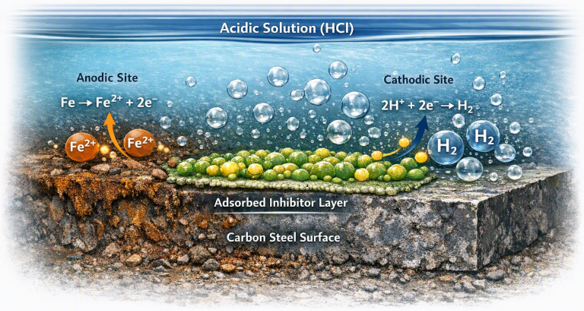
Figure 1
Localized electrochemical corrosion and adsorption mechanism of green corrosion inhibitors on carbon steel in acidic medium.
Note. AI-generated scientific illustration created using Microsoft Copilot AI Image Generator. The author subsequently adapted the figure to represent anodic and cathodic electrochemical reactions, as well as inhibitor adsorption phenomena commonly reported for carbon steel corrosion in acidic environments. The scientific concepts were based on published corrosion literature (Gentil, 2011; Jones, 1996; Verma et al., 2018).

Figure 2
Conceptual comparison between an unprotected carbon-steel surface and a surface protected by an adsorbed inhibitor film.
Note. Panel (A) represents a carbon-steel surface exposed to an acidic environment without corrosion protection, showing localized attack and corrosion-product formation. Panel (B) illustrates a surface protected by an adsorbed green inhibitor film, which acts as a barrier against charge transfer and aggressive ionic species. The image was generated using the Microsoft Copilot AI Image Generator and scientifically adapted by the author based on mechanisms and surface features described in the corrosion science literature (Gentil, 2011; Jones, 1996; Verma et al., 2018).
Table 1.
Representative Green Corrosion Inhibitors and Reported Inhibition Performance in Acidic Media
Green Inhibitor Source | Principal Active Compounds | Corrosive Medium | Reported Inhibition Efficiency (%) | Reference |
Citrus sinensis peel extract | Limonene, flavonoids, polyphenols | 1.0 M HCl | >90 | Santos et al. (2017) |
Spent coffee grounds (Coffea arabica) | Chlorogenic acid, caffeine, phenolics | HCl solutions | 88–94 | Source article; Rocha et al. (2014) |
Plant-derived extracts (general) | Alkaloids, tannins, flavonoids | Acidic media | Typically high; system dependent | Verma et al. (2018) |
Ferrous-alloy green inhibitors (reviewed extracts) | Polyphenols and heteroatom-containing organics | Acidic media | Variable; dependent on concentration and adsorption | Salleh et al. (2021) |
Note. Reported efficiencies depend on inhibitor concentration, exposure time, temperature, steel composition, and electrolyte chemistry. Values shown summarize data discussed in the reviewed literature and are intended for comparative academic purposes.
Tags:


Comments