Vol. 11, No. 1 (jul. 2026), eblg005
Updated: Jul 13
ATMOSPHERIC CORROSION: ENVIRONMENTAL INFLUENCES, MATERIAL PERFORMANCE, AND PROTECTION STRATEGIES
Blog Prof. Ricardo Luiz Perez Teixeira, Itabira, v. 11, n. 1, eblg005, 2026.
ISSN: 3086-5557
06/07/2026
Amanda Moreira Santos¹, Ingrid Lorrainny Santos Martins², Lucas Giarola Chinellato³, Ricardo Luiz Perez Teixeira⁴
¹ Undergraduate Student, Materials Engineering Program, Institute of Integrated Engineering (IEI), Federal University of Itajubá (UNIFEI), Itabira Campus, Minas Gerais, Brazil.
E-mail: amandamoreira2010@gmail.com
² Undergraduate Student, Materials Engineering Program, Institute of Integrated Engineering (IEI), Federal University of Itajubá (UNIFEI), Itabira Campus, Minas Gerais, Brazil.
E-mail: ingridmartins@unifei.edu.br
³ Undergraduate Student, Materials Engineering Program, Institute of Integrated Engineering (IEI), Federal University of Itajubá (UNIFEI), Itabira Campus, Minas Gerais, Brazil.
E-mail: lucaschinel@gmail.com
⁴ Professor, Institute of Integrated Engineering (IEI), Federal University of Itajubá (UNIFEI), Itabira Campus, Minas Gerais, Brazil.
Ph.D. in Engineering.
E-mail: ricardo.luiz@unifei.edu.br
Corresponding Author: amandamoreira2010@gmail.com
Abstract
Atmospheric corrosion is one of the most widespread degradation mechanisms affecting metallic structures exposed to outdoor environments. The phenomenon results from the interaction between metallic surfaces and atmospheric agents such as oxygen, moisture, airborne salts, sulfur compounds, and suspended particulate matter. These interactions promote electrochemical reactions that progressively degrade structural integrity, durability, and mechanical performance, resulting in significant maintenance costs worldwide.
This study presents a literature-based assessment of atmospheric corrosion mechanisms, environmental factors that drive degradation, and engineering strategies to mitigate corrosion damage. The research was developed through a bibliographic review of scientific publications retrieved from the CAPES Journal Portal and classical references in corrosion science, atmospheric exposure, and weathering steel performance (Fontana, 1986; Leite, 2020; Morcillo et al., 2013).
The reviewed studies demonstrate that atmospheric corrosion is strongly influenced by environmental variables including relative humidity, time of wetness, chloride deposition, sulfur dioxide concentration, temperature, and airborne pollutants. Carbon steels generally exhibit higher corrosion rates because the corrosion products formed are porous and weakly protective, whereas weathering steels can develop stable corrosion-product layers that reduce degradation under favorable environmental conditions (Leite, 2020; Pannoni, 2004; Yamashita et al., 2006).
The results highlight the importance of integrating material selection, atmospheric corrosivity evaluation, protective coatings, structural design, and maintenance planning to reduce corrosion-related failures. Therefore, atmospheric corrosion should be considered during both the design and operational phases of engineering systems to ensure long-term durability and reliability (Ahmad, 2006; ISO 9223, 2012).
Keywords: atmospheric corrosion; weathering steel; carbon steel; atmospheric exposure; corrosion prevention; materials engineering.
Introduction
Corrosion is a natural degradation process resulting from chemical or electrochemical interactions between a material and the surrounding environment. In metallic materials, corrosion leads to thickness reduction, mass loss, deterioration of mechanical properties, and premature structural failure. This phenomenon represents one of the principal causes of economic losses associated with industrial infrastructure and metallic structures worldwide (Gentil, 2003; Ahmad, 2006; Callister & Rethwisch, 2016).
Atmospheric corrosion is the most common form of corrosion because it affects metallic structures continuously exposed to environmental conditions. Bridges, industrial facilities, transmission towers, pipelines, roofs, vehicles, and civil infrastructure are examples of components vulnerable to atmospheric degradation. The severity of corrosion depends on environmental exposure, particularly moisture, oxygen availability, and contamination by chlorides and industrial pollutants (Fontana, 1986; Gentil, 2003).
The corrosivity of atmospheric environments can be classified according to variables such as time of wetness, sulfur dioxide concentration, and airborne salinity. These parameters are recognized by ISO 9223 as the principal factors governing atmospheric corrosion processes and determining environmental corrosivity categories (ISO 9223, 2012).
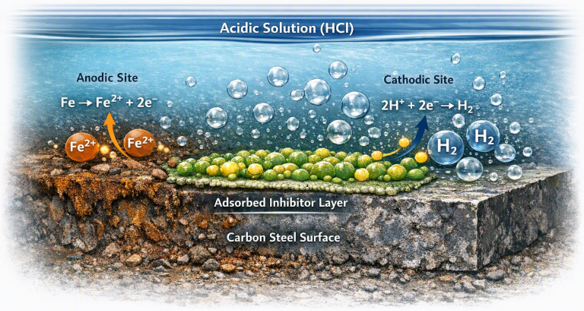
Atmospheric corrosion becomes particularly severe in marine and industrial regions where chloride aerosols and pollutant emissions intensify the formation of electrolyte films on metallic surfaces. The interaction among these factors promotes electrochemical cells that accelerate material degradation, as shown schematically in Figure 1 (Fontana, 1986; Ahmad, 2006).
Materials and Methodology
The study was developed through a qualitative literature review using publications retrieved from the CAPES Journal Portal. Searches were conducted using keywords associated with atmospheric corrosion, corrosion mechanisms, weathering steels, atmospheric corrosivity, and corrosion prevention. Priority was given to peer-reviewed publications, technical books, conference proceedings, and academic theses directly related to corrosion science and materials engineering (Leite, 2020; Ahmad, 2006).
The selected literature included classical references on corrosion engineering, atmospheric exposure studies, investigations involving carbon steels and weathering steels, and publications addressing environmental corrosivity and corrosion-product characterization (Fontana, 1986; Gentil, 2003; Morcillo et al., 2013).
The information was analyzed and organized to identify the principal degradation mechanisms, environmental variables affecting corrosion behavior, differences in material performance, and engineering practices used to prevent corrosion damage. The analysis emphasized atmospheric exposure in industrial and marine-influenced environments, as these conditions pose significant challenges to structural durability (Leite, 2020; ISO 9223, 2012).
Results and Discussion
The reviewed studies indicate that atmospheric corrosion is controlled primarily by environmental conditions. Relative humidity, wet–dry cycles, chloride deposition, sulfur dioxide concentration, and temperature directly influence the formation of electrolyte films on metallic surfaces and therefore affect corrosion rates (ISO 9223, 2012; Ahmad, 2006).
The general corrosion mechanism is illustrated in Figure 1. Atmospheric moisture acts as an electrolyte, while oxygen participates in electrochemical reactions that promote metal oxidation. In marine and industrial atmospheres, chloride ions and pollutants increase electrolyte conductivity and accelerate the propagation of corrosion. Such behavior has been extensively described in corrosion engineering literature (Fontana, 1986; Gentil, 2003; Ahmad, 2006).
Studies performed in marine-industrial environments revealed that corrosion aggressiveness increases significantly when airborne chlorides, sulfur dioxide, particulate matter, and high relative humidity occur simultaneously. Leite (2020) reported that environmental conditions strongly influenced corrosion-product evolution and material degradation, particularly in structures exposed near industrial facilities and coastal regions.
The principal forms of atmospheric corrosion identified in the literature are summarized in Table 1. Uniform corrosion, galvanic corrosion, crevice corrosion, pitting corrosion, and erosion-corrosion represent the most frequently reported degradation mechanisms in atmospheric exposure conditions. The occurrence and severity of each mechanism depend on local environmental conditions and material characteristics (Fontana, 1986; Gentil, 2003; Ahmad, 2006).
A comparison between carbon steels and weathering steels demonstrates the importance of alloy composition for corrosion resistance. Carbon steels generally form porous, poorly adherent corrosion products that allow continued penetration by corrosive species. Conversely, weathering steels can form more compact and stable corrosion-product layers, commonly referred to as patinas, that limit the progression of corrosion under adequate environmental conditions (Pannoni, 2004; Morcillo et al., 2013).
The improved performance of weathering steels is associated with the formation of protective oxide phases. Yamashita et al. (2006) demonstrated that corrosion-product composition and structure significantly influence resistance to atmospheric degradation. Dense oxide layers enriched with stable phases provide better protection and reduce long-term corrosion rates when compared with conventional carbon steels.
The reviewed studies also emphasize the importance of preventive measures. Protective coatings, galvanization, weathering steels, periodic inspections, environmental monitoring, and structural design strategies that avoid water retention and contaminant accumulation contribute to corrosion mitigation. Effective prevention requires integration between corrosion science, materials engineering, environmental characterization, and maintenance management (Callister & Rethwisch, 2016; Ahmad, 2006; ISO 9223, 2012).
Acknowledgments
This work was developed within the extension project Seminar on Corrosion and Materials Degradation – EMTi21 (PJ167-2026) at the Federal University of Itajubá (UNIFEI), Itabira Campus, coordinated by Ricardo Luiz Perez Teixeira. The project integrates teaching, research, and extension activities in Materials Engineering and promotes scientific communication related to corrosion science, sustainability, technological education, and engineering practice (Teixeira, 2016; Teixeira, 2019a; Teixeira, 2019b).
Conclusions
Atmospheric corrosion remains one of the most important degradation mechanisms affecting metallic materials exposed to environmental conditions.
The reviewed studies demonstrate that corrosion behavior depends on both environmental variables and material characteristics. Weathering steels generally outperform conventional carbon steels because of their ability to develop protective corrosion-product layers.
The results reinforce the importance of proper material selection, environmental assessment, corrosion monitoring, protective coatings, and preventive maintenance programs to increase structural durability and reduce lifecycle costs.
Video Presentation Entry:
References
Ahmad, Z. (2006). Principles of corrosion engineering and corrosion control. Butterworth-Heinemann.
Callister, W. D., Jr., & Rethwisch, D. G. (2016). Materials science and engineering: An introduction (9th ed.). LTC.
Fontana, M. G. (1986). Corrosion engineering (3rd ed.). McGraw-Hill.
Gentil, V. (2003). Corrosão (3rd ed.). LTC.
ISO. (2012). ISO 9223: Corrosion of metals and alloys—Corrosivity of atmospheres—Classification, determination and estimation. International Organization for Standardization.
Leite, A. O. S. (2020). Avaliação da corrosividade atmosférica e do desempenho de aços carbono e patináveis em uma termoelétrica no Nordeste do Brasil (Master’s thesis, Universidade Federal do Ceará).
Morcillo, M., Chico, B., Díaz, I., Cano, H., & de la Fuente, D. (2013). Atmospheric corrosion data of weathering steels: A review. Corrosion Science, 77, 6–24.
Pannoni, F. D. (2004). História, comportamento e usos dos aços patináveis na engenharia estrutural brasileira. In Anais do 59º Congresso Anual da ABM (pp. 678–689).
Teixeira, R. L. P. (2016). Educação em práticas de corrosão e química (Version 02, Vol. 1, No. 1, p. eblg001). Blog Prof. Ricardo Luiz Perez Teixeira, Itabira. https://doi.org/10.5281/zenodo.20290724
Teixeira, R. L. P. (2019a). Oficina de siderurgia e oficina de corrosão (Version 02, Vol. 4, No. 1, p. eblg001). Blog Prof. Ricardo Luiz Perez Teixeira, Itabira. https://doi.org/10.5281/zenodo.20291858
Teixeira, R. L. P. (2019b). Dissemination of the Processing and Materials Workshop for Engineering. Blog Prof. Ricardo Luiz Perez Teixeira, Itabira. https://doi.org/10.5281/zenodo.20291985
Yamashita, M., Miyuki, H., Matsuda, Y., Nagano, H., & Misawa, T. (2006). Protective ability of rust layers formed on weathering steel exposed to various environments. Corrosion Science, 48, 2799–2812.
Figures & Tables

Figure 1
General mechanism of atmospheric corrosion affecting metallic structures exposed to outdoor environments.
Note. Atmospheric corrosion results from the interaction between metallic substrates and environmental factors such as oxygen, moisture, chlorides, sulfur compounds, and airborne particulate matter. Adapted from concepts presented by Fontana (1986), Gentil (2003), Ahmad (2006), and Leite (2020). [jove.com], [ar.inspire...pencil.com]
Table 1
Table 1
Principal forms of atmospheric corrosion and their engineering consequences.
Corrosion Type | Main Characteristics | Engineering Consequences |
Uniform Corrosion | Relatively homogeneous attack across the exposed surface | Thickness reduction and loss of material |
Galvanic Corrosion | Occurs between electrically connected dissimilar metals | Accelerated degradation of the less noble metal |
Crevice Corrosion | Develops in confined regions with limited oxygen access | Localized attack and premature failure |
Pitting Corrosion | Produces highly localized cavities and perforations | Structural perforation and leakage |
Erosion-Corrosion | Combined action of corrosion and mechanical wear | Accelerated material removal |
Note. Adapted from Fontana (1986), Gentil (2003), Ahmad (2006), and Callister and Rethwisch (2016).
Tags:


Comments